

Earl Meets Barney: Bringing a Clever Cutting Horse to Life Through Art
Sep 19, 2026
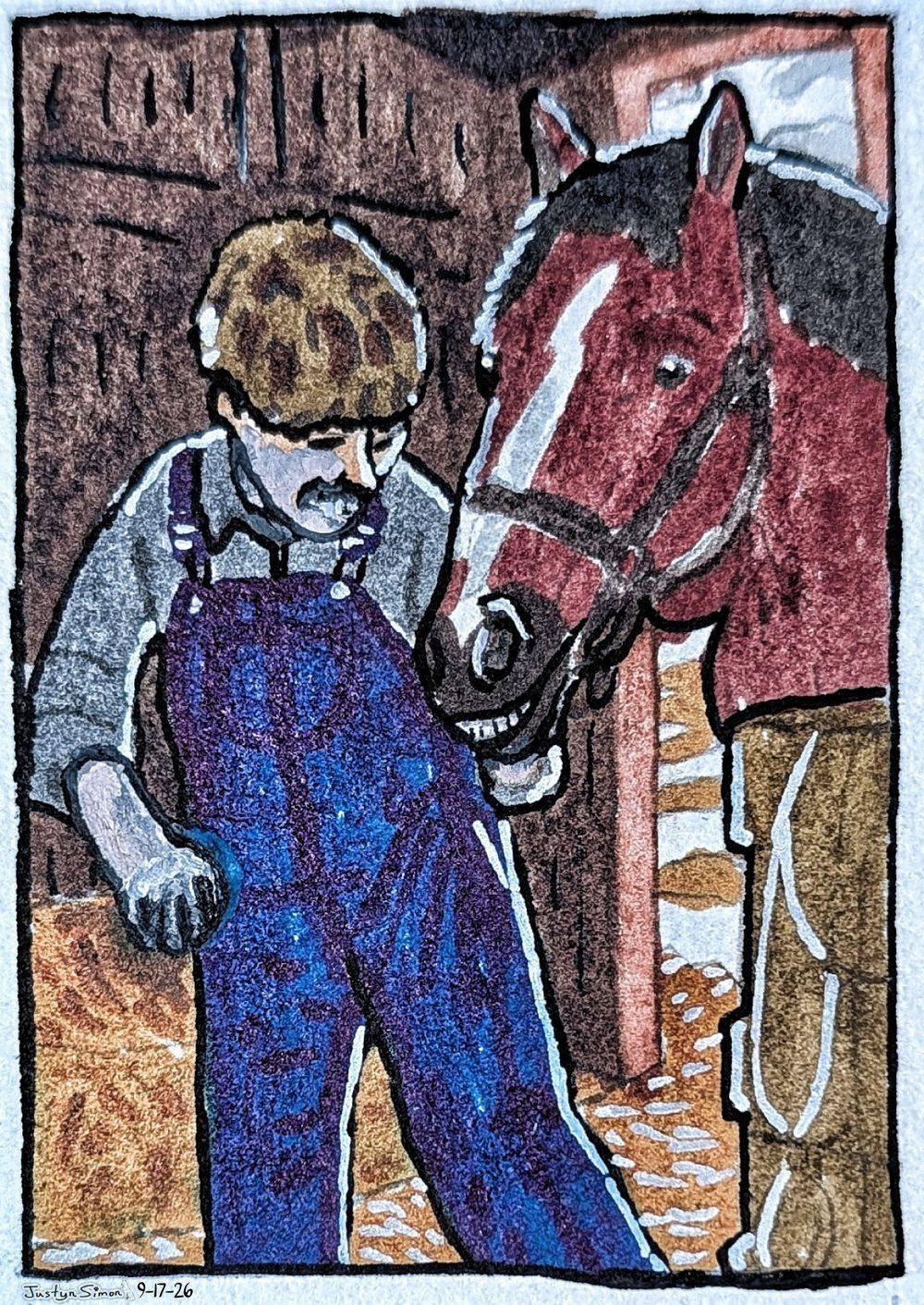
Some family stories stay memorable because of a major historical event. Others survive because of a person—or, in this case, an animal—with an unforgettable personality.
For Episode 5 of The Biography of Earl Dewey Fisher, I created Earl Meets Barney, an ACEO-sized mixed-media artwork inspired by Chapter 4 of History of Earl Dewey Fisher. This chapter takes me back into the childhood of my great-great-grandfather, Earl Dewey Fisher, and introduces one of the more entertaining animals from his memories: a clever cutting horse named Barney.
The finished artwork is more than a horse portrait. It represents young Earl learning to overcome his initial fear of horses and beginning to experience a part of rural life that would become one of the stories he preserved for future generations.
Earl Learns to Ride
Earl learned how to ride a horse when he was quite young, but his introduction to riding wasn't exactly fearless.
He remembered his brother lifting him onto a great big horse when he was still very small. Earl was frightened, and all he could do was sit on the horse and cry.
Eventually, things changed.
Earl learned how to ride and became comfortable enough to ride a cutting horse. These horses were used to separate individual cattle from a herd, which required them to turn very quickly. Earl remembered having to hang on when the horse made those sudden movements.
Despite the challenge, Earl proudly remembered that he never fell off.
Meet Barney the Cutting Horse
The cutting horse Earl remembered was named Barney, and simply being good at his job wasn't what made him memorable.
Barney was smart.
Very smart.
He was also apparently quite fond of making things difficult for anyone attempting to ride him without a saddle.
Earl remembered that if someone tried climbing onto Barney, the horse would reach around, grab hold of their pant leg, and pull them back down. Barney wasn't trying to bite or hurt them—he simply wasn't going to make climbing onto his back easy.
Finding something tall enough to jump from didn't necessarily solve the problem either.
Someone could bring Barney alongside a wagon or another raised object, and he would stand there looking as though he were asleep. As soon as the person jumped toward him, Barney would step inward at just the right moment and send them right over.
And then, if they tried climbing back onto him?
Barney could go right back to pulling on their pant leg.
Barney the Escape Artist
Barney's intelligence didn't stop with avoiding bareback riders.
Earl remembered that Barney couldn't simply be tied up with an ordinary knot. He had to be secured with a double knot, or he would pick at the rope until he managed to turn himself loose.
Even shutting him inside the barn wasn't necessarily enough.
If the barn door was secured with a hook, Barney could use his lips to flip the hook upward and let himself out.
It's easy to understand why Earl still remembered this particular horse when he later recorded his life history.
Creating Earl Meets Barney
For my illustration, I decided to focus on young Earl standing beside Barney.
Rather than attempting to show one of Barney's tricks, I wanted the artwork to feel like an introduction to the two of them—the moment when we meet the young Earl and the horse who is about to become such a memorable part of this chapter.
That's where the title came from:
Earl Meets Barney
I created the artwork as an ACEO, giving this particular piece a small and intimate format that I think works nicely with the childhood memory behind it.
I started by using Da Vinci Eye to help me trace the initial composition. I drew the outline with a mechanical pencil and used artist tape to hold the artwork securely in place.
Once I finished the remaining sketch details, I used a kneaded eraser to lighten the pencil lines.
From there, I brought the illustration to life using:
- Watercolor pen
- India ink pen
- Acrylic paint pen
The watercolor helped establish the color throughout Earl, Barney, and the barn environment, while the ink and acrylic paint pen allowed me to strengthen details and give the finished artwork its distinctive illustrated appearance.
After completing the physical drawing, I used Snapseed and Procreate to edit the digital version and prepare the artwork for sharing online and producing prints.
Watch Earl Meets Barney Come to Life
I recorded the later stages of creating the artwork and turned the footage into a sped-up drawing video for:
The Biography of Earl Dewey Fisher | Episode 5: Barney the Cutting Horse
I enjoy making these videos because they provide another way to preserve the process behind the project. You can see the artwork progress from the pencil WIP into the colorful finished illustration while learning about the story that inspired it.
Own the Original Earl Meets Barney ACEO
For this chapter, I'm doing something a little different with the original artwork.
The one-of-a-kind original ACEO of Earl Meets Barney is available through Tiny Gallery.
You can view the original here
There is only one physical original. The Tiny Gallery listing is for the actual hand-created ACEO made with the traditional materials described above.
The sale of the original does not include reproduction rights, since I am also making the image available as prints.
Earl Meets Barney Fine Art Prints
If you enjoy the artwork but would prefer a print, Earl Meets Barney is also available through The Artistic Shepherd.
I'm offering open-edition prints, and Earl Meets Barney is also part of my limited-edition print collection for collectors who would like a more exclusive version of the artwork.
This gives you different ways to collect the piece while allowing the original ACEO to remain completely unique.
Preserving Earl's Story One Artwork at a Time
One of my goals with The Biography of Earl Dewey Fisher is to do more than simply retell my great-great-grandfather's history.
I want to illustrate it.
Some chapters contain major events. Others preserve smaller memories of childhood, family members, places, everyday life, and animals like Barney. Those smaller stories are an important part of understanding who Earl was and what his world was like.
Barney may have been a cutting horse, but Earl remembered much more than what the horse was trained to do. He remembered his intelligence, his tricks, and all the little behaviors that made Barney an individual.
More than a century later, that personality still comes through in Earl's words.
With Earl Meets Barney, I now have another piece of that story preserved visually as well.
And there are many more chapters—and many more artworks—still to come.