
No Job Too Big: Illustrating Hard Work in Earl Dewey Fisher’s Family Story
Sep 30, 2026
Family history isn't always made up of major historical events. Sometimes the smaller memories—working a farm, gathering firewood, raising turkeys, or making sorghum—tell us just as much about the people who came before us.
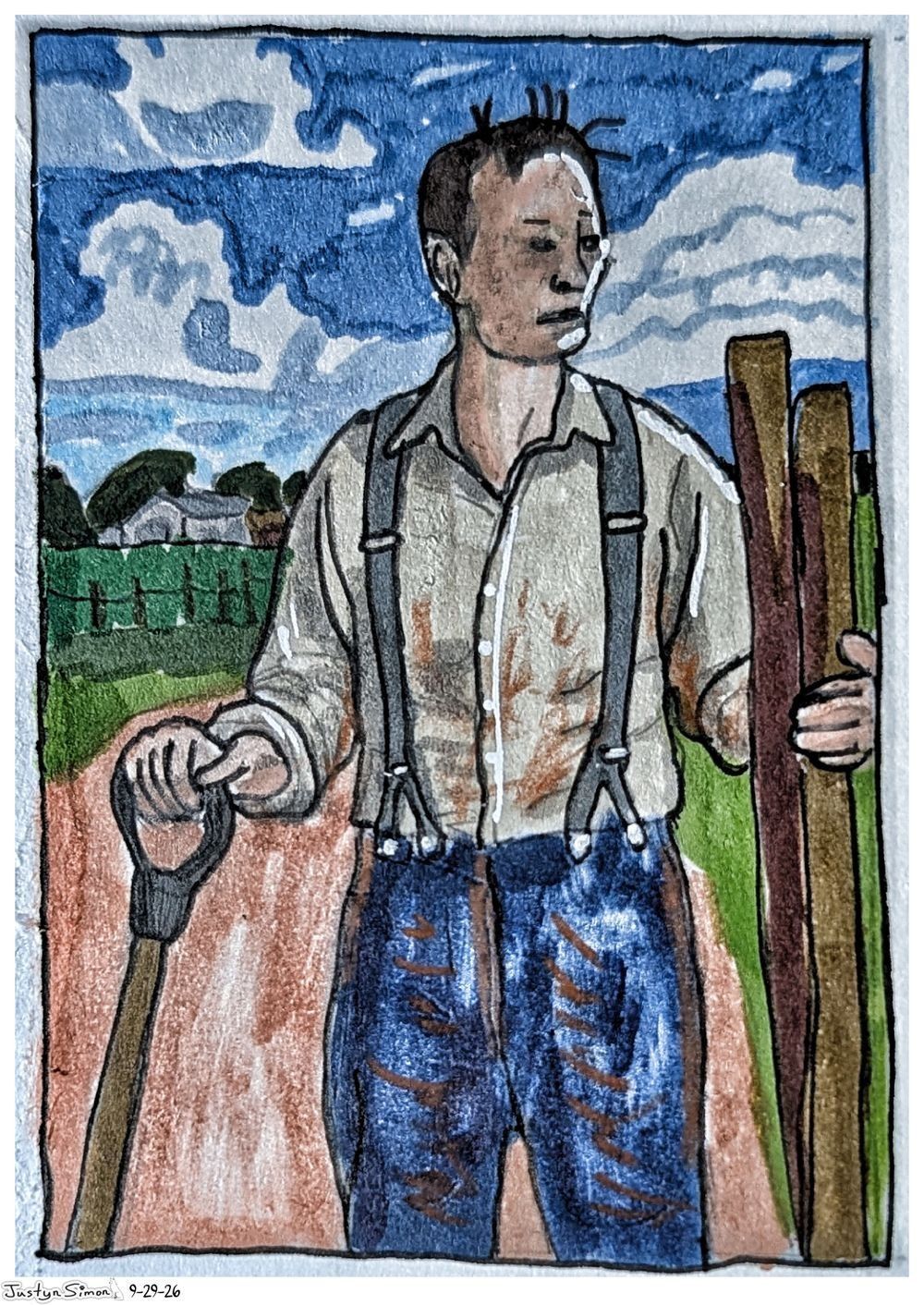
My latest artwork in The Biography of Earl Dewey Fisher series is called No Job Too Big. It accompanies Chapter 5 of the preserved life story of my great-great-grandfather, Earl Dewey Fisher, and Episode 6 of my video series, “Work, Discipline, and Daily Life.”
This time, the artwork focuses on Earl's father and the work ethic that Earl remembered so clearly.
“No Job Was Too Big”
One passage from Chapter 5 immediately stood out to me:
“Father was always a very energetic man. No job was too big or hard for him to try and do it.”
That sentence became the inspiration for both the composition and the title No Job Too Big.
Earl described his father as a relatively small and slim man, but his physical size certainly didn't stop him from working. With a large family to provide for, he farmed and took whatever other work he could find.
Instead of illustrating one specific event from the chapter, I wanted this artwork to represent that larger idea.
I depicted Earl's father standing outdoors with a shovel, surrounded by fence posts and farmland. The shovel and rural environment represent the many different kinds of physical work that were simply part of providing for the family.
Work Was Part of Family Life
Chapter 5 contains several fascinating glimpses into how Earl's family lived and worked.
His mother raised turkeys and sold them in the fall. The money wasn't simply extra income—it had a particular purpose. She used it to purchase winter bedding and clothing for the children to wear to school.
Earl also remembered his father making sorghum.
Cane was processed using rollers powered by an old blind horse walking in a circle. The juice was then boiled in open vats and moved from one vat to another as the sorghum was made.
Another memory involves gathering wood for the family's stoves.
Earl's father had both horses and mules. When bringing wood home, he could send the team of mules ahead while he drove the horses. The mules knew the routine well enough to pull their wagon home, stop at the woodpile, and wait there until he arrived to unload them.
Those are the kinds of details I find especially interesting about this biography. They aren't just names and dates. They show how people worked, solved problems, raised families, and went about ordinary life.
Work, Discipline, and Daily Life
Work is only one side of Chapter 5.
Earl also describes his father as a strict but fair parent. When his father gave the children an instruction, they knew they were expected to obey it. Earl remembered his mother differently: although she might fuss at the children, they knew they could sometimes get away with things they wouldn't attempt with their father.
The chapter includes memories of the corporal punishment used within the family, including Earl's recollection that his father would wait until he was no longer angry before administering punishment.
These memories provide another glimpse into the household and parenting practices Earl experienced growing up.
That's why I chose Work, Discipline, and Daily Life as the title for Episode 6. Together, these stories create a portrait not just of Earl's father, but of the household in which Earl grew up.
Creating No Job Too Big as an ACEO
There's another thing that makes this piece different from some of the other artwork in this project:
The original is tiny.
No Job Too Big is an ACEO measuring just 2.5 × 3.5 inches.
I created the original artwork on Bristol paper using:
-
Mechanical pencil
-
Colored pencil
-
India ink pen
-
Fineliner pen
-
Acrylic paint pen
I also used a kneaded eraser during the drawing process.
Working at ACEO size meant fitting the figure, shovel, fence posts, house, and surrounding landscape into an area roughly the size of a traditional trading card.
Once the physical artwork was finished, I photographed/scanned the piece and edited the image used online with Snapseed and Procreate.
The original physical artwork remains a traditional mixed-media ACEO.
The Original and Prints
One thing I'm doing differently with No Job Too Big is making the original miniature artwork available separately from the prints.
The original 2.5 × 3.5-inch ACEO is available through Tiny Gallery
The print listing includes both print options and a limited edition version, allowing the imagery of this tiny original to be enjoyed at a larger scale.
Watch Episode 6
No Job Too Big accompanies:
The Biography of Earl Dewey Fisher | Episode 6: Work, Discipline, and Daily Life
The video continues my project of working through Earl's preserved biography chapter by chapter and creating artwork inspired by the people, places, and experiences he remembered.
Preserving Everyday History Through Art
One of the things I've come to appreciate while working through Earl Dewey Fisher's story is how important seemingly ordinary memories can become.
A man going out to work.
A mother raising turkeys.
A horse turning a sorghum mill.
Mules waiting patiently beside a woodpile.
These weren't necessarily extraordinary events when Earl experienced them. They were everyday life.
But generations later, those details give us a window into a world that would otherwise be gone.
That's what No Job Too Big represents to me. It isn't simply an image of a man holding a shovel. It's a small visual tribute to the work, responsibility, and determination that Earl remembered as part of his father's character.
And fittingly, that story is now preserved in an artwork only 2.5 × 3.5 inches—a tiny piece of art carrying a much larger family story.
No tail left untold.